

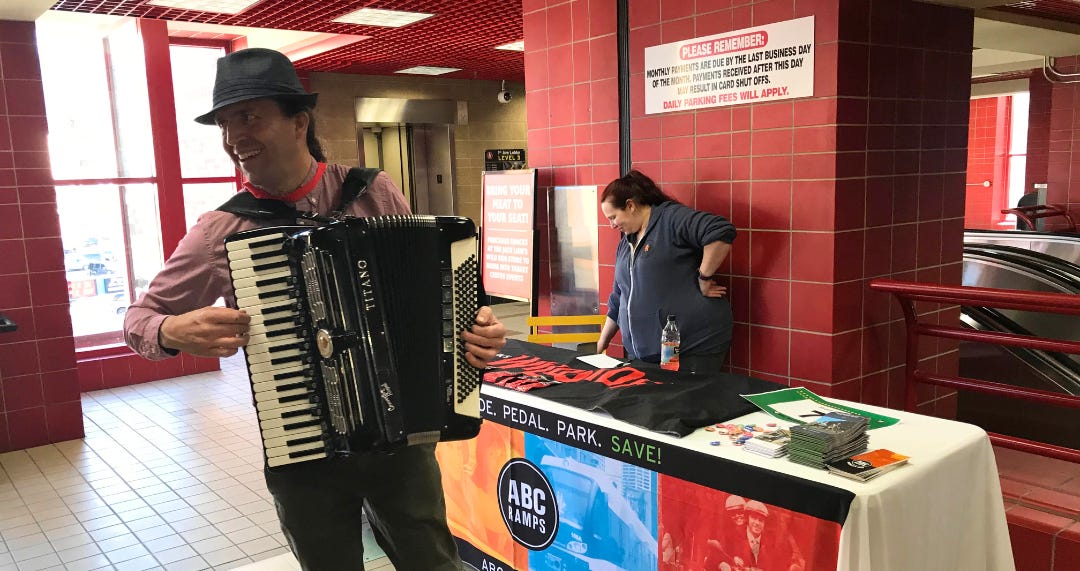
There can be hand-wringing around focusing too much on the “perception” rather than the reality of safety. There is certainly a realm where one can over-accommodate what is actually masked prejudice. But most often, a focus on making a space feel safe creates the conditions that make it actually safe, for everyone.
So what is our charge for creating spaces that feel and are safe?
It’s focusing on actions and experiences, not people and demographics. The former leads us to a dangerous realm of profiling and exclusion. The latter opens us up for true invitation and fair consequences for actions that put others at a risk of harm.
Six features of places that have real and perceived safety:
All are welcome in the space as a baseline invitation that is communicated formally and informally;
There are a multitude of positive things to do in the space via some combination of furnishings, functional uses, activities and events, which attracts people and creates rewards for good behavior;
Consequences for actions that put other people at risk for harm are communicated and enforced, but only after the invitation of features 1 and 2 are in place;
The space communicates that it is cared for through it’s physical upkeep and the visible presence of formal and informal care providers;
The design of a space allows several sight-lines in and out and avenues of access and egress from all places;
Messaging about positive features is carried through formal and word of mouth channels.
Conversely, when thinking about places that don’t feel safe, often you’ll find:
Very little to attract people to the space beyond something they are forced to do, such as a transportation use
The space is full of garbage
Furnishings prioritize their ease of being cleaned (“hose-downable”) not quality of experience they provide
Threats of punishments are made without invitation or anything positive to do as an alternative
Providers of care - formal or informal - are rarely if ever seen
There are many blind corners and spaces where one could be trapped
The messages about the space are only negative
Safety in numbers
William H. Whyte made the thoughtful observation about how safety is created in urban public and shared spaces - that there is safety in numbers.

What the horseshoe line tells us is that there are two ways to achieve safety.
Option 1 is to eliminate all people from a place so that only you and those you know personally are in the space. This is only possible in rural and truly private environments. In a city of any real size, certainly any commercial district or park, it is effectively impossible to eliminate use to just you and those you know. For even if that was the case in a public space, there is always the possibility of an unknown person(s) coming into the space at any time. And as we know, expectations about the possible future affect our feelings, current and future behavior. Empty urban spaces feel uncomfortable and unsafe.
Option 2 is to have lots of people in a space at once, or “eyes on the street”. Even if you do not know most or any of the people you are sharing public space with, that together everyone is doing their small part to embody and uphold positive social norms.
And we’ll only attract and retain enough people to a place to make it be and feel safe if there is a sufficient amount of…
Positive Activity as a Goal and Strategy
Without positive activity, we’ll only get people in a space because they have to be there, or they are up to no good.
With only the threat of punishment without invitation and positive things to do, there’s no incentive for good behavior.
The only way to create sustained safety for everyone is by creating places where people want to be.
Share this post with someone who needs to know!
Further Reading…
Case Study: Creating safety at an urban transit hub through positive activity
Learn how we increased the number of those who felt safe at a downtown transit hub from 46% to 89% through activation. www.musicantgroup.com/projects/pop-ups-at-central-station
