
What You're Saying About "Placemaking"
Practitioners weigh in on the use and abuse of the term - a collaborative post with Project for Public Spaces

Our “Placemaking is Dead, Long Live Placemaking” article really struck a cord with fellow practitioners about the complications of the term that so often is used to define what we do.
After re-publishing the article with Project for Public Spaces, we partnered with them to survey practitioners on how the term “placemaking” affects the work of improving our public spaces. 295 placemakers weighed in, surfacing a few nuances the original article hadn’t fully captured. The following is a summary of the survey findings.
Practitioners Are Living All Three Traps Named in the Article
We asked which of the three pitfalls with the term “placemaking” named in the article do practitioners encounter the most:
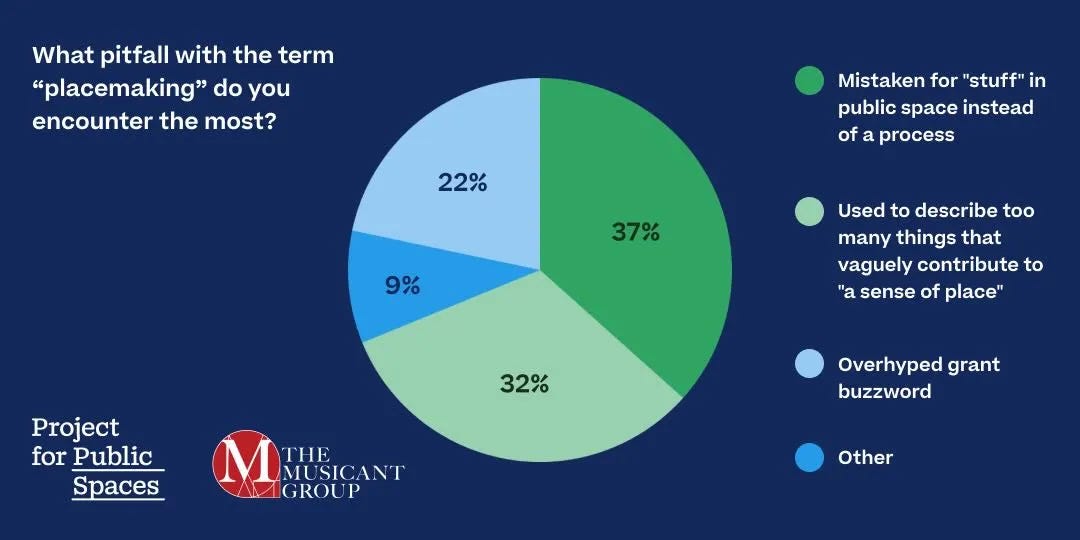
All three traps seem to be alive and well in practice. As the article posits, the term “placemaking” doesn’t just suffer from one distortion, but rather three, which is why it has stopped functioning as a reliable shorthand.
Many of those that chose “other” described the term being abused to cover for gentrification or let governments say they were listening, while ignoring harder, more pressing issues.
The term can hide disagreement
We asked people to describe a time poor communication got in the way of good placemaking. Forty-seven people wrote in, with most centered on the experience of different parties using the same word to mean incompatible things, and not discovering that out until they were well into the project.
A few patterns recur across the responses:
Silent divergence in what “placemaking” even meant. A consultant was hired thinking they were helping create a walkable Main Street; the client thought they were buying retail marketing and better signage. A local government passed an ordinance using the term “placemaking” and discovered the five members of the governing body had five different definitions of it, which stalled implementation.
Decisions announced instead of made together. Multiple respondents described “placemaking” being introduced “after the decisions had been made,” or placemaking projects framed as collaborative when no real input process existed. A word meant to describe a process, was instead used to describe outcomes that skipped the process entirely.
Placemaking treated as an event with a start and end, not an ongoing commitment. Several respondents described the same failure differently: a physical improvement or event labeled as placemaking and celebrated as a “success,” with no plan for who maintains it, no continued community involvement, and no mechanism to sustain what was built. One respondent tied this directly to disappointment: when communities think the activity is the final result rather than a step in an ongoing process, they feel let down once the activation ends and nothing changes.
A better future for the term and practice
When we asked for further thoughts on the term, a few themes emerged.
Strong agreement with the article’s premise. Many respondents thanked us for publishing the article that named a frustration they hadn’t been able to articulate, and a few expressed relief that a term they’d quietly grown skeptical of was being named as a problem rather than a professional failing on their part.
“People before place.” Others pushed the critique one step further than the article did. They said placemaking, as practiced, too often starts with the physical space rather than the people already using it.
From process to product, and back again. Overall, respondents called for re-centering the interdisciplinary process required to improve places, whether it’s called “placemaking” or not. The confusion over the term reveals a deeper challenge in the work itself.
So here’s to better language that can support more impactful practice.
Do you have more to share?
If you haven’t added your voice yet, we’d still love to hear it. Take the survey!